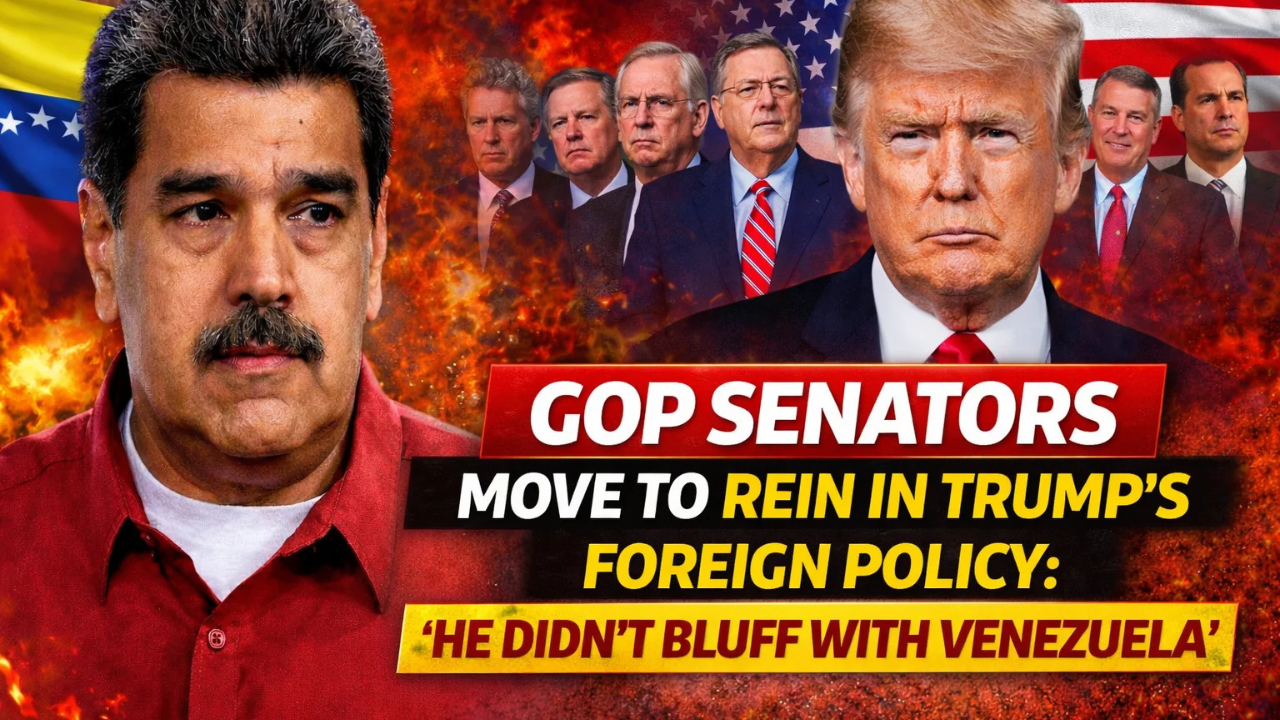
The arrest of Nicolás Maduro following a U.S. military operation has sent shockwaves not only through Venezuela and Latin America, but also through Washington itself. Inside the United States Senate, the action has triggered a rare moment of resistance from within President Donald Trump’s own party. A growing group of Republican senators is now moving to rein in Trump’s foreign policy authority, warning that the president’s decisive use of military force in Venezuela proves he was not bluffing — and that unchecked executive power could pull the country into deeper international conflicts.
The internal GOP pushback highlights rising anxiety over constitutional boundaries, congressional authority, and the long-term consequences of unilateral military action. While Trump’s allies praise his willingness to act decisively, critics within the party argue that the Venezuela operation crossed a dangerous line.
Venezuela as a turning point in Washington
For years, Trump’s foreign policy style has been defined by unpredictability, strong rhetoric, and a willingness to challenge norms. However, many lawmakers had assumed that some of his most aggressive threats were strategic pressure rather than signals of imminent action. The arrest of Maduro shattered that assumption.
The operation demonstrated that Trump was prepared to use direct force to achieve geopolitical goals, even without explicit congressional authorization. For several Republican senators, this moment became a wake-up call. Venezuela, they argue, is not just another foreign policy episode but a turning point that forces Congress to confront how much power the president is exercising abroad.
The phrase repeated by several lawmakers — “he didn’t bluff with Venezuela” — has become shorthand for their concern that future actions could follow the same pattern, potentially involving U.S. forces in prolonged or escalating conflicts.
A rare GOP rebellion on war powers
In response to the Venezuela operation, a bipartisan group of senators moved to advance a war powers resolution designed to limit the president’s ability to conduct further military actions without congressional approval. While such resolutions are not new, what makes this moment significant is the number of Republicans willing to challenge a president from their own party.
These senators argue that the Constitution clearly grants Congress the authority to declare war and oversee military engagements. From their perspective, Trump’s unilateral decision undermines that balance and risks normalizing executive-led military action without democratic accountability.
Several GOP lawmakers stressed that their opposition is not rooted in sympathy for Maduro or his government, but in concern over precedent. If one president can authorize military operations on his own authority, they warn, future presidents could do the same under far less scrutiny.
Constitutional concerns take center stage
At the heart of the Senate debate is a fundamental question: where does presidential authority end, and where must congressional oversight begin?
Critics of Trump’s Venezuela strategy argue that the administration relied on expansive interpretations of executive power, stretching existing legal frameworks to justify the operation. They fear that this approach weakens Congress’s role in shaping foreign policy and erodes the checks and balances that are central to the U.S. political system.
Supporters of the war powers effort insist that their actions are not an attempt to weaken national security, but rather to protect democratic governance. They argue that requiring congressional approval does not prevent military action; it ensures that such actions are debated, justified, and supported by the representatives of the American people.
Trump’s response and growing party tensions
President Trump has reacted sharply to Republican dissent. In public statements and private conversations, he has accused critical senators of undermining national security and emboldening America’s adversaries. Trump maintains that, as commander in chief, he has both the authority and responsibility to act swiftly when U.S. interests are at stake.
The president has framed the Venezuela operation as a decisive victory, portraying it as proof that strength and resolve can achieve results where diplomacy failed. From his perspective, congressional hesitation risks projecting weakness and inviting further instability abroad.
This clash has deepened divisions within the GOP. While many Republicans remain loyal to Trump and support his hard-line approach, others are increasingly uncomfortable with the concentration of foreign policy power in the White House.
Bipartisan momentum builds in the Senate
Although Republican resistance has drawn the most attention, Democrats have largely unified behind efforts to constrain the president’s authority. The war powers resolution gained momentum precisely because it crossed party lines, signaling broader unease about executive overreach.
Some senators described the measure as a “constitutional reset,” intended to remind both the president and the public that military decisions carry immense consequences and should not rest with one individual. Even lawmakers who typically support strong national defense policies expressed concern about the lack of clear objectives and post-operation planning in Venezuela.
The bipartisan nature of the effort has given it symbolic weight, even as questions remain about whether it can survive a potential presidential veto or gain traction in the House of Representatives.
Venezuela’s ripple effect on U.S. foreign policy
The fallout from the Maduro arrest extends far beyond Capitol Hill. Allies and adversaries alike are reassessing U.S. intentions, trying to determine whether Venezuela represents an isolated case or a new model for American intervention.
Some Republican senators worry that Trump’s actions could destabilize regions already on edge, particularly if adversaries interpret the move as a sign that Washington is willing to bypass international norms. Others fear that U.S. allies may hesitate to cooperate if they believe decisions will be made unilaterally and without consultation.
These concerns have fueled calls within Congress for clearer strategies, defined limits, and stronger oversight of military operations abroad.
The broader GOP identity crisis
The debate over Venezuela has also exposed a deeper identity struggle within the Republican Party. Traditionally associated with strong executive leadership and assertive foreign policy, the GOP now finds itself divided between loyalty to a powerful president and commitment to constitutional restraint.
For some senators, opposing Trump on war powers is a matter of principle, not politics. They argue that defending congressional authority today protects the party — and the country — from abuses of power tomorrow, regardless of who occupies the White House.
Others see the challenge as politically risky, warning that public dissent could fracture party unity and weaken the administration’s ability to act decisively on the world stage.
Public opinion and political risk
The internal GOP conflict is unfolding against a backdrop of mixed public opinion. While some Americans support strong action against authoritarian leaders abroad, others are wary of military involvement following decades of costly interventions.
Republican senators pushing back against Trump are acutely aware of the political risks. Challenging a popular president within the party can invite backlash from voters and party leadership alike. Yet several lawmakers have argued that constitutional responsibility outweighs short-term political calculations.
Their stance reflects a belief that voters ultimately expect lawmakers to act as a check on power, not merely as supporters of the executive branch.
What happens if Congress succeeds
If the war powers resolution advances and survives the legislative process, it could significantly reshape the balance of power between Congress and the presidency. Even if Trump vetoes the measure, the vote itself sends a strong signal about congressional intent and limits.
A successful effort would not undo the Venezuela operation, but it could constrain future military actions and force greater transparency and debate. Supporters believe this would restore a measure of predictability and accountability to U.S. foreign policy.
Critics, however, argue that such limits could slow response times and complicate national security decision-making in fast-moving crises.
A defining moment for Trump’s presidency
The Venezuela episode and the resulting GOP backlash may come to define Trump’s second-term foreign policy legacy. His willingness to act boldly has energized supporters and unsettled critics, both at home and abroad.
For Republican senators, the moment represents a test of institutional integrity. The question they face is whether to defer to a powerful president or assert Congress’s constitutional role, even at the cost of party unity.
Conclusion
The move by GOP senators to rein in President Trump’s foreign policy marks one of the most significant internal challenges of his presidency. The arrest of Nicolás Maduro proved that Trump’s threats were real and that his administration is willing to use force without traditional congressional approval.
As lawmakers debate war powers, constitutional authority, and America’s role in the world, Venezuela has become more than a foreign crisis — it is a catalyst for a broader reckoning in Washington. The outcome of this struggle will shape not only Trump’s foreign policy but also the balance of power between Congress and the presidency for years to come.